Collective Euphoria After France Reached the World Cup Final
And Their Children After ThemCollective euphoria after France reached the 1998 World Cup final transforms football success into a temporary experience of national belonging, sweeping through Heillange’s shops, homes, bars, and streets. The celebrations make a shared country feel tangible across class and geography, and briefly loosen the distance between Anthony and Hacine. Yet the unity is presented as a powerful moment rather than a permanent change: its inclusive language coexists with skepticism and political division, while the old grievances between individuals have not simply vanished.
From everyday errands to national anticipation
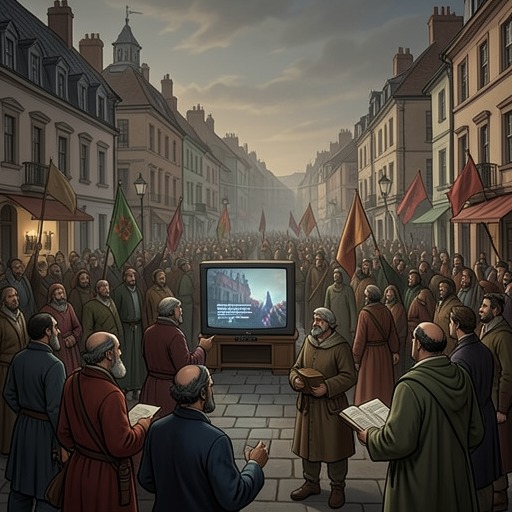
The mood gathers momentum before the semifinal. At E.Leclerc, France’s progress is announced over the loudspeakers, and the store promotes discounted televisions for the occasion. Anthony goes back across the crowded electronics department and buys a forty-inch Sony set, using a check despite being overdrawn and relying on the option to pay in installments. His purchase is practical, but it is also drawn into the wider event: as he watches football highlights among children and other shoppers, his private longing seems to merge with a national aspiration shared across Heillange and Paris, across social ranks, and from children to public figures.
At home, the television carries the buildup into Anthony’s living room. Commentators describe France as a great football nation playing on home ground amid unprecedented popular fervor, while the possibility of the match becomes a national rendezvous with destiny. The confidence is conditional: the team must not become overconfident, and everything seems to depend on Zinedine Zidane staying on his feet. Anthony drinks whiskey, eats in front of the new screen, and follows the reports as his excitement rises. But the interruption of the broadcast leaves him alone with his reflection in the dark screen and his sadness returns. The contrast shows how national anticipation offers him a temporary escape from private distress without erasing it.
A shared match, a fragile consensus
The match extends the spectacle into ordinary domestic life. At Anthony’s cousin’s home, football dominates conversation as the family prepares to watch. Nath rejects the idea that the team’s mix of Black, white, and Arab players will leave a lasting social legacy, treating the so-called black-white-brown unity as a passing fashion. Her experience as a police officer informs a wary, protective cynicism; Anthony’s cousin disagrees and believes a victory could leave something behind. Their exchange establishes that the meaning of the celebration is contested even before the game begins.
Outside, the neighborhood’s anticipation takes on a common rhythm: firecrackers and car horns sound in the distance, children race about shouting for Les Bleus, and televisions glow in homes where people gather to watch. At the barbecue, food and chilled rosé accompany the preparations; Nath, in her third month of pregnancy, grows tired and dozes during the first half. The match itself is tense rather than triumphant at first. France plays cautiously, Croatia threatens, and Anthony and his cousin react anxiously as the French side struggles. The nationwide celebration is therefore not a simple expression of confidence. Suspense, uncertainty, and the possibility of defeat are part of what binds spectators to the same unfolding event.
The goal that brings former antagonists together
In a bar, the first of Lilian Thuram’s goals changes the atmosphere at once. Hacine enters, recognizes Anthony, and turns toward the screen. When Thuram scores in the forty-seventh minute, the crowd erupts; Anthony, overwhelmed by happiness, shakes Hacine, who raises both fists. Their spontaneous contact matters because they had spent the evening avoiding one another. For a moment, the match supplies a setting in which that avoidance gives way to shared celebration.
The second goal, scored by Thuram in the seventieth minute, intensifies the sense of collective release. The narration describes spectators as melded into a horde, with distinctions temporarily seeming to disappear and the country encountering itself in a fantasy of fraternity. The language makes the power of the occasion clear, but also qualifies it: this is a temporary imaginative unity, not proof that history, debts, or social differences have ceased to exist. Anthony and Hacine both drink heavily as the match continues, swept into the bar’s exhilaration. When France wins and reaches the final, the emotional high has made a brief approach between them possible; it has not yet resolved the history that kept them apart.
Heillange celebrates, and the boundaries remain
At the final whistle, Heillange spills into public celebration. Cars jam the streets with their horns sounding; flags appear at windows and wave above the crowds; faces are painted in the national colors, young people set off firecrackers, and people toast one another on the sidewalks. Some celebrants climb onto car hoods and move through the traffic by jumping from one vehicle to another. The police watch indulgently, while passersby stop to embrace and kiss them. At City Hall, champagne is opened. The town seems to discover, after three decades of bad luck, that it still possesses energy and collective strength.
The celebration’s vocabulary is strikingly inclusive: people speak as a collective, claiming that the country has won and that it is going to the final. Algerian flags also appear in the streets, while a local body-shop owner’s earlier banner endorses Zinedine Zidane for president. At the same time, the National Front office has temporarily pulled down its iron shutter. These details place signs of plural belonging alongside evidence of political exclusion; the match does not settle the tension between them. Nor does the carnival atmosphere abolish every boundary. The next encounter between Anthony and Hacine comes only around midnight or one o’clock, outside L’Usine, after much of the crowd has gone home. They have spent the evening largely avoiding each other, and it takes the late hour, drink, victory, and a powerful mood of amnesty for one of them to speak. The euphoria thus creates an opening, not a permanent reconciliation: its significance lies in making a different encounter briefly imaginable.